
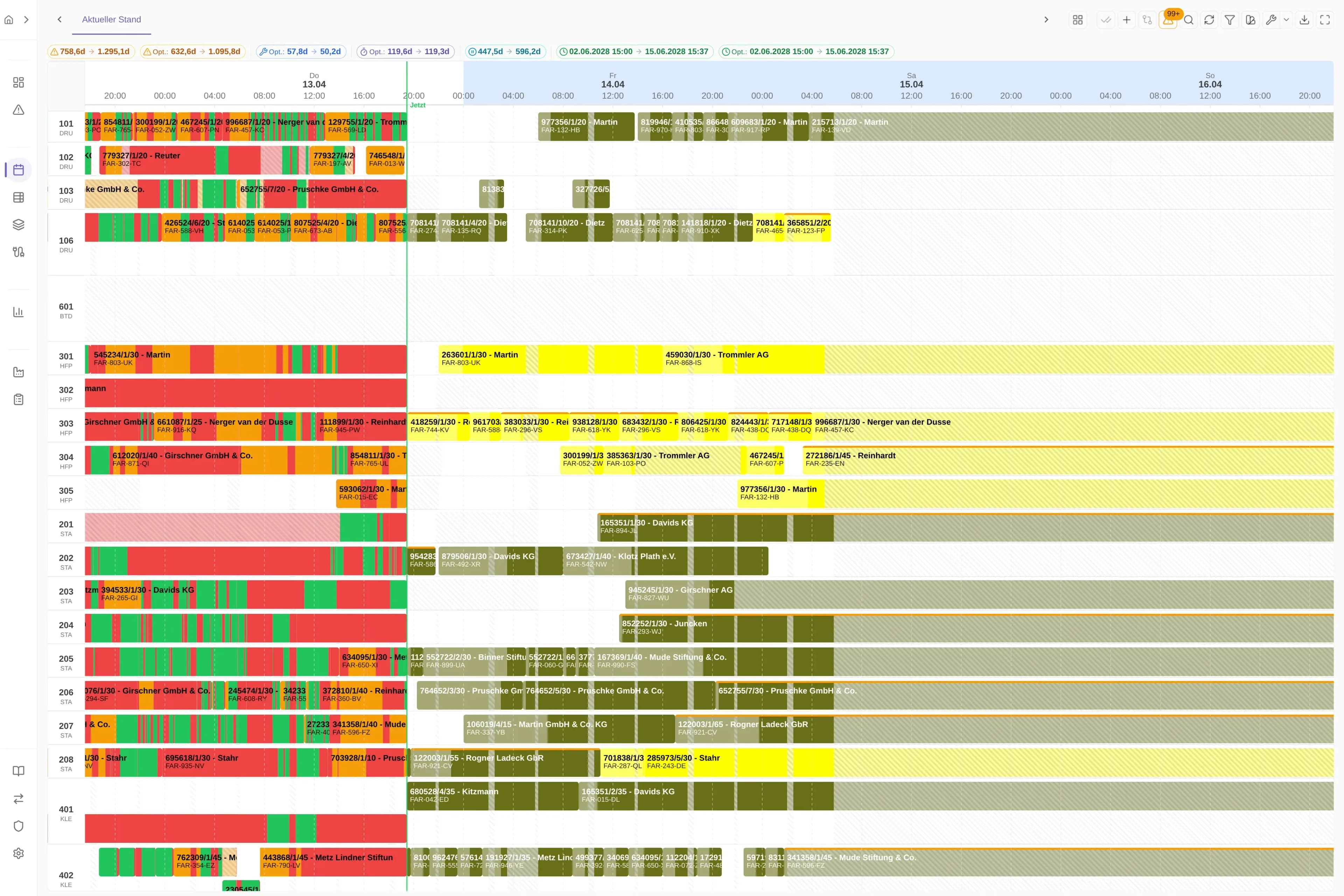
In many packaging companies, the production plan still lives in an Excel sheet. It costs the planners hours every day, barely reacts to the next rush order, and never shows what is actually running on the machines. Riventic Flow takes this work off your hands: a web-based production planning system that mirrors your production in real time and optimizes it in the background with simulation. The AI works through the sequences, while the decision stays with your planners. No suggestion reaches the ERP without their approval.
Planning on an interactive Gantt chart
At the center sits a Gantt chart that shows your shop floor as it is: one row per machine, each order a block with its ID, status, progress, and markers for due date and material. Your planners drag an order to its new position, and Flow immediately factors in the consequences, including a preview of the setup-time delta and the downstream shifts. Only after confirmation does the system reschedule the dependent steps. Anyone who prefers working in numbers switches to the detailed planning table with one click and edits many orders at once. Both views show the same plan and stay in sync at all times.
Optimization at the push of a button
The real lever is the optimization core, Riventic Core. At the push of a button, it rearranges the plan for one or more machines so that setup times fall, idle time shrinks, and deadlines hold. Behind it works simulation-based optimization: a genetic algorithm searches through thousands of possible sequences, and a discrete-event simulation tests each one against the real constraints of your production before it appears as a suggestion. Every suggestion arrives with its costs and benefits laid out, and your planners decide whether to adopt it. Nothing changes on its own.
Models that learn from your data
Flow does not plan with blanket figures; it learns from your plant's data. Trained models predict realistic setup and run times and propose production groups, that is, orders with similar setup characteristics that run well one after another. A plan that looks good in theory becomes one that also works on your shop floor. Each model is versioned and activated in a controlled way, so you can always trace what the plan was based on.
On top of the ERP, not in its place
You don't have to replace anything for Flow. Instead of replacing your ERP or MES, Flow sits on top of it: it continuously reads orders, bills of material, stock, calendars, and operating data, and places plan and reality side by side in the same Gantt. Before optimizing, Riventic Guard checks the data for consistency and flags gaps, so no faulty state enters the planning. A plan only returns to the ERP through a controlled publish step with a dry run, confirmation, and an automatic snapshot. The core stays the same for every customer; only the interface and the connection to your system are tailored, and for that there is usually a standard connector.
Even with more than 400 simultaneously active orders across around 25 machines, an optimization run stays under 15 minutes. Flow runs on-premise in your network, bilingual and with nothing for the user to install.
Built for the packaging industry
Packaging production in particular is a tough planning case, and that is exactly where Flow plays to its strength. An order passes through several stages such as printing, die-cutting, and gluing, each machine with its own constraints. Above all, the setup time depends heavily on the sequence: when orders with a similar format, tool, and color set follow one another, the changeover stays short; when the plan jumps between dissimilar orders, cleaning, color changes, and tool changes add up to expensive downtime. On top of that come tight deadlines, short-notice rush orders, and hundreds of parallel orders across a mixed fleet of machines. By hand, that combinatorial puzzle is almost impossible to control. Flow groups similar orders into production groups, estimates the times realistically, and uses simulation to find the sequence that holds your deadlines and keeps the machines busy.