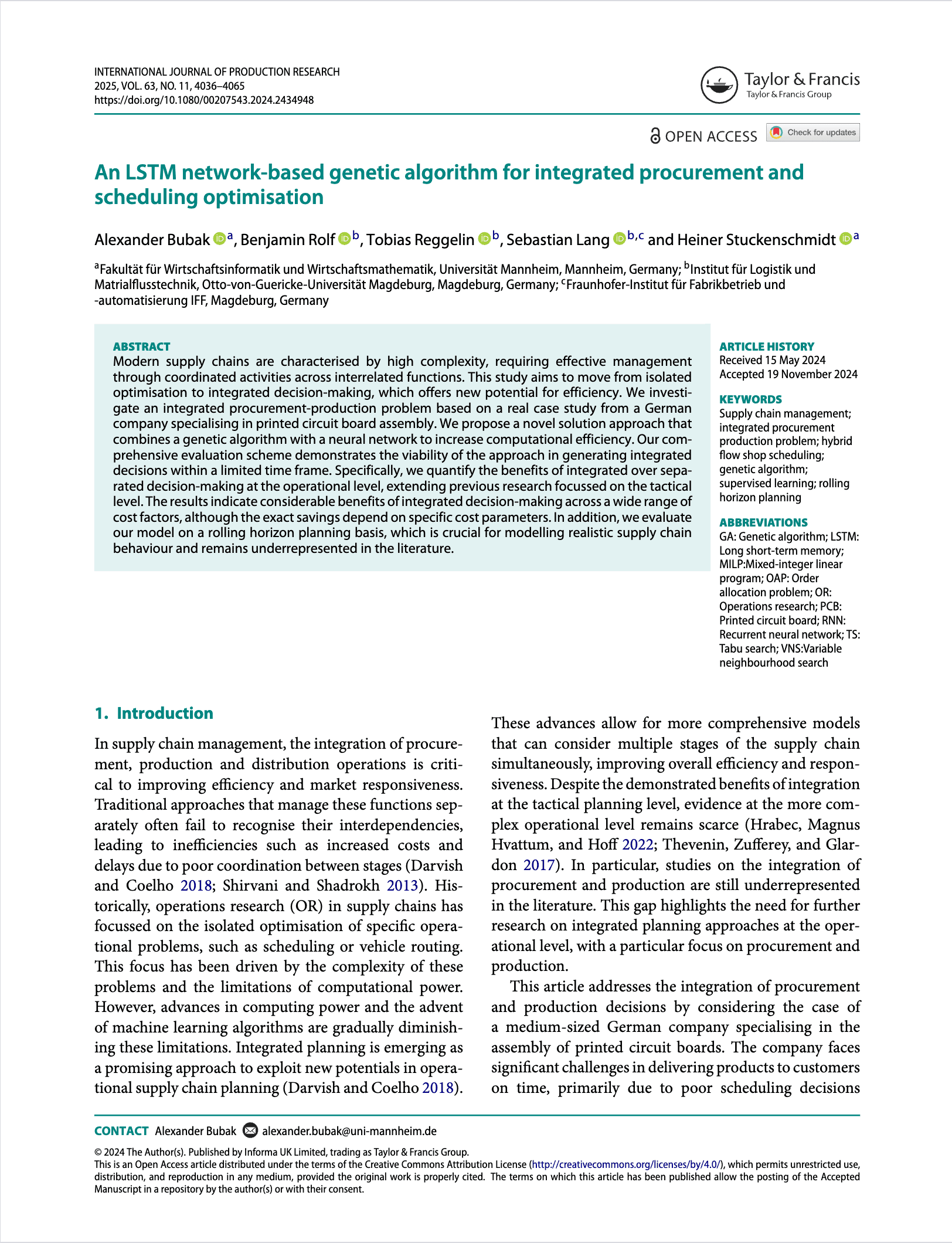
In many companies, two departments plan past each other. Purchasing orders material, production schedules orders, each on its own. When material is missing, orders stall; when purchasing buys ahead, the warehouse fills up and ties up capital. A peer-reviewed study in the International Journal of Production Research, co-authored by Riventic co-founders Benjamin Rolf and Sebastian Lang, shows how to optimize both sides together in one model.
Two plans that don't fit
Procurement and production are tightly coupled. Optimizing them separately gives locally good but, in sum, expensive decisions: the best purchasing plan ignores what production actually needs, and the other way around. The study treats both as a single optimization problem.
Forecasting meets optimization
The approach couples two methods. An LSTM network, a neural network for patterns over time, forecasts future demand. A genetic algorithm, a search method modeled on evolution, tests many possible plans and combines the best ones step by step into a joint solution for purchasing and production. The forecast feeds straight into planning: the model orders and produces what demand is expected to be.
The result
Integrated planning keeps the warehouse neither empty nor overfull and improves on-time delivery, because a shared data basis accounts for purchasing and production at once.
How this connects to Riventic
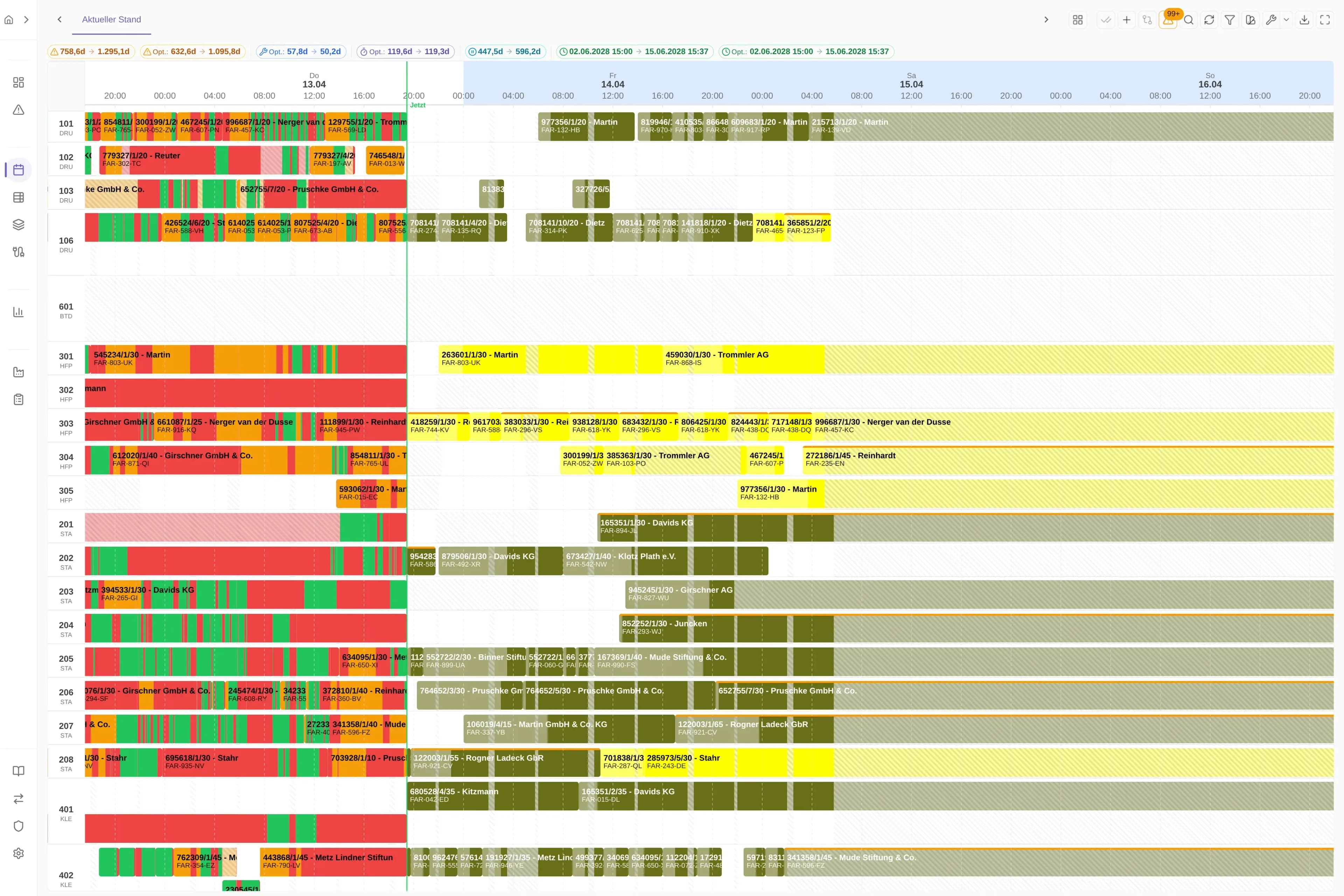
The same interplay of learned forecasting and evolutionary optimization shapes the core of Riventic Flow. There, Riventic combines genetic algorithms with discrete-event simulation and with models trained on each customer's own production data.