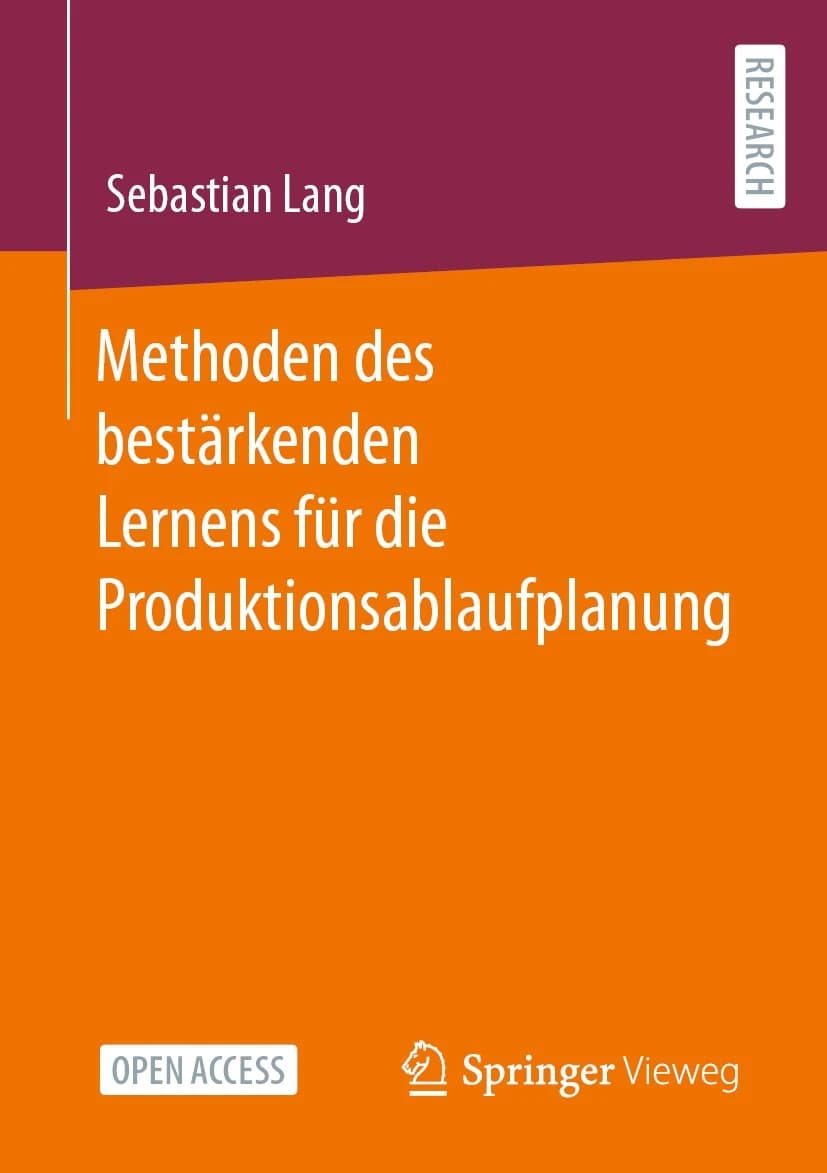
On 21 June 2023, the dissertation by Riventic co-founder Prof. Dr.-Ing. Sebastian Lang appeared with Springer Vieweg: "Methods of Reinforcement Learning for Production Scheduling". The book is freely available in open access.
What it is about
Planning production in real time means deciding again and again which order runs next on which machine, while due dates, setup times and disruptions keep changing. Lang develops a method that combines reinforcement learning with discrete-event simulation. A learning agent makes the sequencing decisions; a simulated model of the shop floor serves as its training ground and checks every decision against the real constraints. The work describes this method and evaluates it on concrete scheduling problems.
Origin and review
The dissertation was written at Otto von Guericke University Magdeburg; the defense took place on 25 January 2023 and was graded summa cum laude. The reviewers were Prof. Dr.-Ing. Michael Schenk (OVGU Magdeburg) and Prof. Dr.-Ing. Sanja Lazarova-Molnar (Karlsruhe Institute of Technology).
Repeatedly recognized
The work later received several honors, among them the BVL Science Award Logistics 2024 from the German Logistics Association, the OVGU dissertation prize, and the 2023 VDI advancement award.
Connection to Riventic
The combination of learning and simulation developed here shapes the approach Riventic takes to production planning. In the product Riventic Flow, the optimization core couples a discrete-event simulation with AI-driven optimization and with models trained on each customer's own production data.